22 July 2026
Here's the latest news from Black Square's Nick Cyganski - read on for more about the Black Square Commander 114 for MSFS 2020/2024 which is scheduled for release soon, the forthcoming Twin Commanders and also Black Square's King Air Professional. (Click on the images for a larger version.)
My apologies for keeping you all waiting so long for this update. As my projects grow in complexity, and as I strive to experience more of these aircraft in person, development can appear to slow down at times, but I’m always working on new aircraft and features behind the scenes.
Although the
Black Square Commander 114 will be the next of my aircraft to release, I would like to start with a long overdue update on the Twin Commanders.

For those just learning about the project, the Black Square Twin Commanders will include the Turbo Commander 690B and its reciprocating engine counterpart, the Aero Commander 685. This pair will differ the most compared to other Black Square duos, despite their similar airframes, offering vastly different flying experiences.

When I decided to undertake bringing these aircraft to MSFS, I significantly underestimated their uniqueness and complexity. Truth be told, I began regretting the decision until I was invited by the most welcoming pilot in Arizona to experience the TC690 for myself. We spent the whole day recording audio, investigating systems, taking reference photos and finally logging some time before sunset.
My host, Tim, has a YouTube channel,
Flying Wild AZ, which features full flights, deep dives into Twin Commander systems and many other flying adventures. I have no doubt that it will become a favourite of my users while learning the Twin Commanders.

At the level of detail that I aspire to create in each of my aircraft, there really is no substitute for spending time with the pilots who operate them daily. The Twin Commander’s systems are particularly unique, so we came prepared to discuss the minutiae before making observations in flight. The result is an experience surprisingly different from other Black Square aircraft with these eccentric machines.
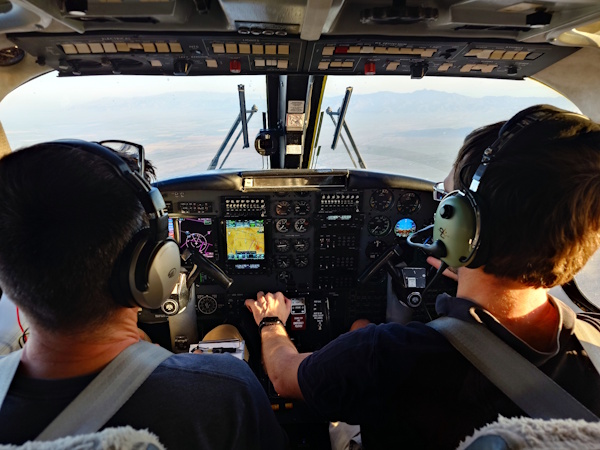
My trial-by-fire began even before reaching the runway, as I learned how to use my toes to actuate the aircraft’s hydraulic steering through gentle, almost meditative adjustments. This is one feature I could not miss in my virtual aircraft. In flight, the aircraft had a surprisingly smooth feeling. Despite appearances with the 6ft-tall landing gear, the airframe coaxed me into a smooth landing, aided by the seating position being so near the ground.
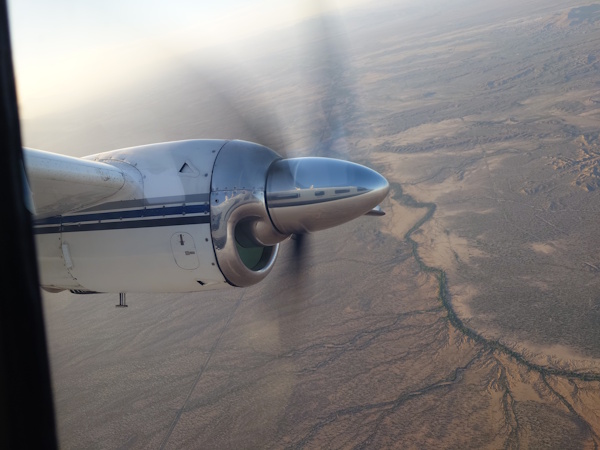
The engines felt quite distinct, in operation and sensation, from free turbines, and required a watchful eye for someone more familiar with the PT6. Since this is my first aircraft to feature the TPE331 geared turboprop engines, I was exceptionally lucky to have this opportunity to operate them from taxi to shutdown. We even demonstrated the negative torque system (NTS) in flight and manually unfeathering the propellers before start-up.
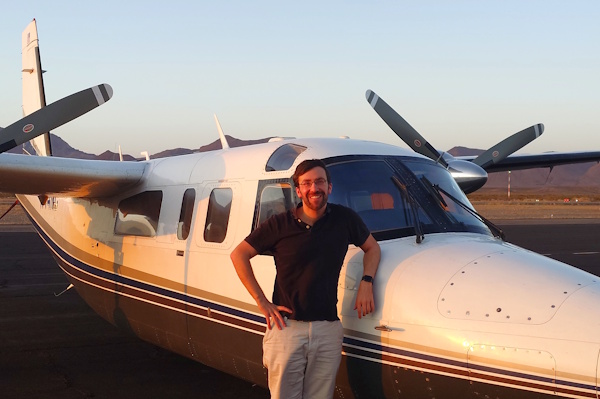
After the trip, any regret about undertaking these complicated and quirky beasts was replaced by excitement at bringing those same features to life in code. I cannot wait to share them with you all, like they never have been represented in a flight simulator before. Thank you so much to Tim for hosting me in Arizona - your generosity and care for these aircraft will certainly be evident in the final product.


Apart from the numerous 'Commanderisms' that I’m excited to share, this will also be the first Black Square aircraft modelled and textured professionally. The result is an aircraft with noticeably more realistic wear and materials, inside and out. However, I wanted to model the instrument panels and avionics myself, to ensure a consistent feel relative to my other aircraft. The instrument panel is the face of the aircraft’s systems, after all.

Although not a conventional beauty shot, I think this view from inside the TC690’s main wheel wells conveys the level of detail possible when splitting the workload like this. Note the pressure gauge on the inboard bulkhead, which is functional, depicting the nitrogen pressure in the emergency landing gear extension system.


While the AC685 shares most of its airframe with the TC690, the cockpit layouts, systems and in-flight operation differ greatly. Notably, the engines also differ from other Black Square piston aircraft, as they are geared reciprocating engines. The GTSIO-520-F is also one of the most powerful horizontally opposed engines ever installed in a production civilian aircraft, at 435 HP each, burning over 50 gal/hr each on take-off. A keen eye will notice the tachometer redline of 3400 RPM (0.667:1 gear ratio) and maximum manifold pressure of 44.5 inHg.

The true passion that leads me to create these aircraft is for learning about their systems and unique character traits. With the Twin Commanders, I was lucky enough to be tutored by someone equally as passionate about this particular airframe. I can only hope that passion will be contagious, and that many more will come to love the novelty of the Twin Commanders.


In the meantime, I invite you to enjoy the Twin Commanders’ little brother, the
Black Square Commander 114. I also travelled to record audio and experience the 114, so I could pack as many new features and systems as possible into this single-engine cross-country machine. In this case, I was lucky enough to fly the exact target year and model, a 1978 turbo-normalised 114.

I recently developed a new full state saving system for the Twin Commander, and decided to add it to the 114 at the last minute. The system is based on the second of two state-saving methods available to me as a developer in MSFS. This system appears to have better consistency across multiple platforms, which gave me the confidence to add persistence to nearly every custom variable in the aircraft. For the Twin Commanders, this is 445 saved parameters, including failures, and 220 for the 114.

The new full state-saving system allows you to choose the level of persistence that you desire via three toggle switches on the tablet’s options page. The system also monitors the phase of flight to ensure that no inappropriate state is loaded; for instance, if you end your flight after a full shutdown and subsequently start a flight mid-air. All saved parameters have defaults for different phases of flight, or even time of day. If you prefer the default states you’re already familiar with in other Black Square aircraft, simply leave all three toggles deselected.

Another significant new feature added with the 114 are multiple new engine sound layers that depict subtle or severe, normal or abnormal, engine operating conditions. I found the effect of these sounds so convincing that they triggered subconscious knowledge of the engine’s state, which is a capability I hadn’t realised I developed during my real-world flying. Other real-world-inspired sounds include airframe vibration/resonance and nose gear shimmy.

You can expect several technical overview videos covering this aircraft’s new features in the coming days, as the release date approaches. Of particular note are the new avionics, hydraulic gear system and functioning stormscope. The aircraft also features two versions: normally aspirated, and turbo-normalised. The turbo-normalised version is additionally equipped with crew/passenger oxygen and an aftermarket air conditioner.

I’m particularly partial to the 114’s warm interior, which makes it feel like home during cross-country flights or sightseeing over cities at night.
Rather than post an exhaustive list of all the new features here, I hope you enjoy this faux magazine feature PDF that I couldn’t resist making for this cozy piston single. Click the image or the link below to see all eight pages:

In addition to the
Feature Highlights PDF, the full 154 page
manual is also now available for perusal.
As is tradition, we also have our First Look video of the Black Square Commander 114 to signal the release of the manual and the beginning of previews from our fantastic community partners.
Lastly, I know many of you are eagerly awaiting information on the
King Air Professional.
As you might have gathered, I want to ensure that the King Air Professional benefits from all my latest features and professional artwork, as I wish for it to be the eponymous king of the Black Square fleet. The King Air Professional will be a 300 model, which combines the shorter fuselage of the 200 with the engines of the 350. Although not the most common model produced, the 300 leveraged a temporary certification window to become the fastest and highest performing of all the King Airs. With a cruising speed of 320 KTAS, climb rates in excess of 3,000 fpm, MGTOW of 14,000 lb, and the mutli-bus electrical system of the 350, I considered the 300 to be the perfect combination of features for the King Air Professional. Of course, with this much effort invested in the systems, I suppose a 1900D announcement was inevitable, wasn’t it?