17 December 2025
F70/100 Professional
Part Three of our 2025 round-up takes us to a progress report on our hotly anticipated, high-fidelity regional airliners: the
F70 Professional and F100 Professional.
Before we delve into the update, though, we have prepared a cinematic video of the aircraft to whet your appetite. This video, recorded with one of the most recent builds, is the most representative look yet at what you can expect to find in these forthcoming MSFS airliners - enjoy it
here!
In the time since our previous update, parts of the AFCAS and FMS code have been refined, improved and in some cases reworked. The complex nature of a ‘modern’ glass cockpit airliner featuring Lateral Navigation and Vertical Navigation means that features such as the AFCAS, FMS, EFIS displays and flight model are all so finely integrated with each other, as well as reliant on so many external variables, that every small change in code to any of those components not only requires a significant amount of testing, but may also require further work on a different section of code whose behaviour may have been affected. The number of integrated systems is, of course, greater on more modern aircraft like the F70 and F100.
We are getting close to the finish line now, with a solid build that we can continue to support for years to come. We appreciate that this is frustrating to many of you who have been eager to take these aircraft into the virtual skies, but we hope that your long term enjoyment of the F70 and F100 will far outweigh the frustration of the delayed release.
(You can click on the screenshots below to see an expanded image.)

The flight model has seen further refinements to three key areas in recent weeks.
The first is the high-altitude performance. In the real-world F70 and F100, the Tay 620-15s were particularly lethargic at high altitude, especially with the F100 at high weights. At maximum take-off weight, a fully laden F100 covers 85 nautical miles over 17 minutes to reach 25,000 feet, but takes almost double that time and distance to climb from 25,000 feet to 35,000 feet. This is something that must be considered during the flight planning phase of every flight, as it may be more efficient to cruise at a lower altitude for longer than to continue climbing.
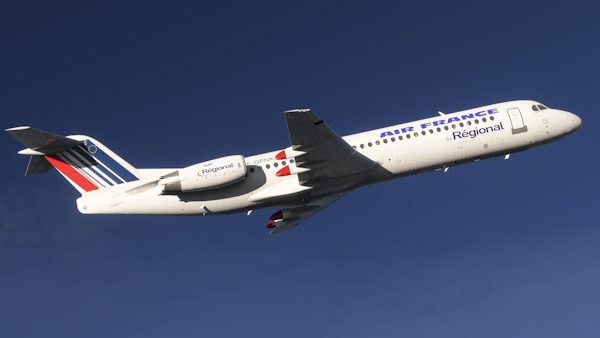
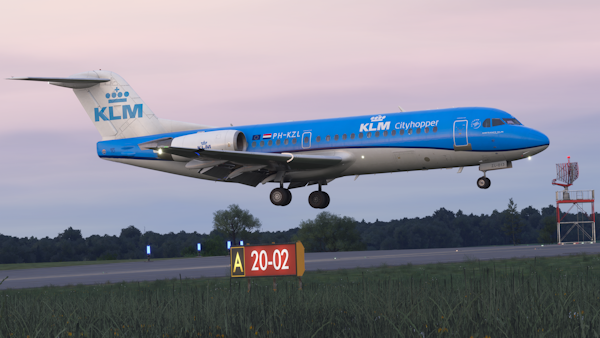
The second aspect of the flight model that has been refined recently is the flare behaviour. Unlike the F28, which shares a similar configuration, it is not standard operating procedure to extend the speedbrake over the threshold unless you’re performing a short field landing; in fact the F70/F100 FCOMs recommend that the speedbrakes remain in the same position (IN or OUT) throughout the entire approach. This difference in procedure, and the higher probability of a lower drag landing compared to the F28, previously made the F70 and F100 a bit too susceptible to ground effect, leading to floating landings. However, based on a vast collection of real-world cockpit videos, we have been able to fine-tune the flare behaviour so that a similar amount of pitch input is required to flare the aircraft as real-world pilots would use.
We are frequently told by their real-world pilots that the F70 and F100 were lovely aircraft to hand fly, and we are certainly feeling that now in the simulator.
The third aspect of the flight model that has been reviewed is the engine parameters during engine start. In a previous development update we covered our own custom EPR (Engine Pressure Ratio) simulation for the F70 and F100, which allows the relationship between EPR, N1, N2 and EGT to be as accurate as possible throughout all phases of flight. One thing we noticed when implementing the sound set was that the engines N1s were running a couple of percent too high when on the ground at idle.
Although this didn't cause any noticeable issues with the physics or other procedures, it did lead to the engine sounds being slightly out of pitch for the idle power setting. Thanks to close collaboration between our flight model and sound developers, this has been corrected and we are seeing accurate engine figures when the engines are at idle. You will also hear the deep, low frequency rumble of the Tay 620-15s at idle power, something that will really make you hold onto your headphones!

In the last few weeks we have received a feature-complete build of the sound set, and our internal testing team is currently providing feedback to our sound developer. As with all our products, he has done a fantastic job of implementing the sound recordings into the simulator – dare we say even surpassing the incredible sound set in our Avro Vulcan B Mk.2, K2, and MRR! The F70/100 Professional sound set surpasses that of the the Vulcan in the number of individual sound samples for the engines, with our sound developer telling us is that it features the highest number of individual sound samples he has ever included in an FS aircraft.
Something that is very difficult to achieve is developing a sound set that makes you feel like you are in the presence of the real aircraft, rather than simply hearing sound recordings of an aircraft playing in the background. With the F70 Professional and F100 Professional your body will vibrate with the low frequency rumble of the engines at idle power (especially in the rear of the cabin), you’ll feel euphoria as the engines are advanced to take-off power and the screaming buzzsaw sound of the Tays overpowers every other sound, and if you’re on the exterior you’ll feel deafened if you attempt to complete a walkaround with the engine or APU running. That doesn't even scratch the surface of the countless unique sounds you'll hear whilst operating the aircraft from the cockpit, or even the cabin announcements such as the Safety Briefing that you'll hear in the cabin during pushback and engine start.
We'll be bringing you an in-depth Sound Overview video in due course, so you'll be able to enjoy the impressive F70/F100 audio experience for yourself.
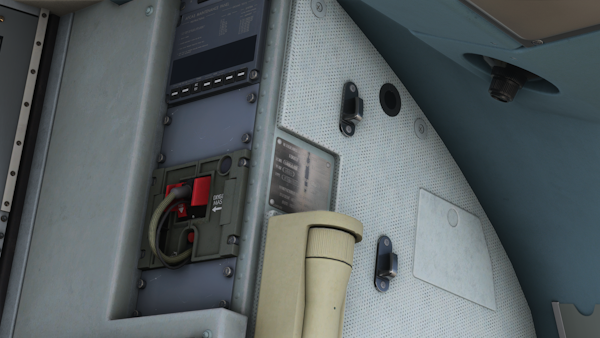
Further work has been completed on the liveries, with the addition of custom data plates for each livery. These data plates are located on the aft wall of the cockpit, behind the Captain’s seat, and the data in each of the four fields will be accurate for each livery. As with our recent 146 Professional and F28 Professional updates, we'll also be giving livery creators the option to include a configuration file with their liveries; if included, this will allow livery creators to have the correct external equipment configuration assigned for their livery by default.
An update such as this one doesn't paint the entire picture of the amount of work that is going on behind the scenes, as a significant percentage of the development is related to code changes which don't lend themselves very well to any kind of visual presentation, but rest assured that we are working flat out on both aircraft and doing our very best to get the F70 Professional and F100 Professional released as soon as possible in 2026.
In Part Four of our End of Year Round Up tomorrow we'll be providing more details of another Just Flight Airliner due for release in the New Year.